Pages

Monday, November 02, 2009

Taking our godliness seriously

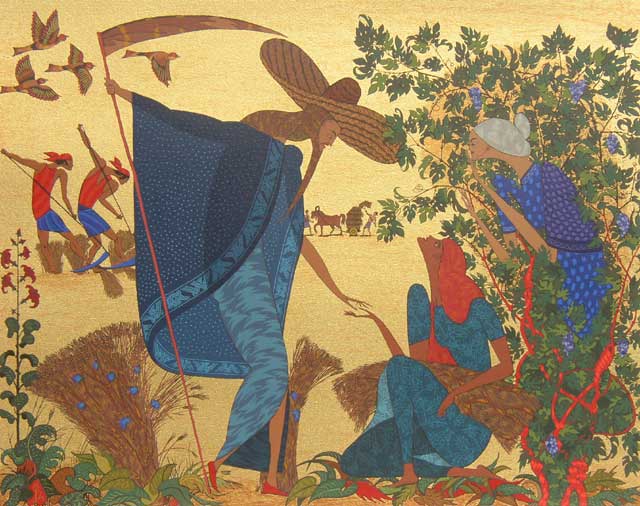
Ruth and Boaz (the stylistic work of Polish-Iraeli artist Shlomo Katz see here for more)

Reading for Pentecost 23, Sunday 8th November 2009 (Proper 32) Ruth 3:1-5, 4:3-17; Psalm 127; Hebrews 9:19-28; Mark 12:38-44

There is certain profound gentleness about this week's readings.
The story of a woman who finds a genuine life partner. And who against all odds becomes the mother of a great man.
And the gentle reassurance of the woman whose generosity is seen by God; even though she gives little in "real terms" she gives everything she has in hers
and God see this
and we recognise it and so we are heartened.
In the middle of this there is something of a sterner reminder
that God abhors hypocrisy
and that there is about life the mystery of sacrifice
which tests us to the very core of who we are.
The writer to the Hebrews spells out in great detail
that sacrifice is at the core of what our relationship with God is all about.
Getting it straight
Now we need to understand that there is a common misconception about sacrifice
and that is that it is essentially about the taking away of life.
This is not necessarily or particularly so. ]
In fact if we look at the detailed instructions about sacrifice in the Hebrew scriptures ]
we see that a lot of it is not about animal slaughter at all
There are all sorts of sacrifices of grain and produce which do not involve bloodshed.
In fact if we look at the word sacri-fice
we can see that it is about making (the fice part of the word) things
sacred or holy (the sacri part of the word)
Christ died that we might be made holy
In fact the writer of Hebrews uses the idea of Christ entering into God's presence
(going into the most holy place)
so that we too might enter into that presence
Simple reflection
The story of Ruth is an interesting but gentle tale.
It seems a simple love story
yet it needs also to be read in the context of the sort of ethnic tensions
that still exist in those lands we call HOLY today.
Ruth was not a Jew she was what today we would call a Lebanese, or Syrian, perhaps even an Iraqi.
Yet her faithfulness to her Jewish mother-in-law
and her willingness to do what needed to be done
saw a simple little tale become an object lesson in the all accepting love of God.
The Jews were racked by ethnic division then as now.
And yet we read of one the greatest heroes (in backwards order)...his father was Jesse, his grandfather was Obed, who was the child not of a Jew but of a Moabitess.
David was the great grandson of an outcast.
Be careful about what you hear.
There is more than meets the eyes.
Likewise in the letter to the Hebrews
it is the call for us to be holy
and the permission to enter the closest presence of God that we need to hear.
Not just the bloody sacrifice of Christ.
So obsessed are we about guilt and sin that we fail to hear that there is cause for rejoicing.
Christ died, so that we could be close to God.
God is close, not far.
Don't push him away
Finally
A simple tale that we all know to be true .. the rich can afford to be generous
But do we also pay attention to the great warning
God is not looking for who gives the most either in real dollar terms or even proportionately.
God looks at the heart and despises hypocrisy.
The hypocrisy that judges others and fails to critique oneself.
THIS WEEK Where is God inviting me to be tolerant?
To step outside my prejudices and to be more accepting?
Where do I hold back from drawing close to God?
Is there a time and place to be quiet and listen?
Is there an opportunity to serve God through care for others?
Where in my life am I most hypocritical? Where can I change and be more honest?

Tuesday, October 27, 2009

More thoughts on the saints

We keep Sunday 1st November as All Saints Day, and 2nd November as All Souls Day...It is a basic tenet of Christian life that the 'communion of saints' is with us in this world and also beyond the grave. I always find this season both encouraging and challenging As the year draws towards its close we move in the Church's year from thinking about day to day life to the fulfillment of the promises of God's kingdom. In the Church of England this season is called Kingdom Time It is, I think, a good name. In my mind it begins around the end of October with the feast of St Simon and St Jude (28th October) So far as we know they are two of the apostles listed in the Gospels but we know very little about them. Jude is traditionally called "The Obscure" meaning that whoever he is we don't actually have any detail.
[Indeed that's why Thomas Hardy reminds us in his dark novel of failed ambition and thwarted hope which is entitled Jude the Obscure(full text here) of a man who fails to make it because he is unknown, unrecognised, unappreciated...he is indeed Obscure]
This feast is a prelude to the great feast day that we encounter on November 1st....All Saints Day...and which is followed the day after by All Soul's Day, when the dead are commemorated We are here in a world which transcends the grave what the Apostle's Creed calls the communion of saints This is heady stuff! Too much for some! But we may be prompted to ask what this is all about Isn't it just religious mumbo-jumbo? Of course it could be, that may indeed be the point. If we get to the guts of it the saints point us to how faith might be lived with authenticity and integrity We are constantly tempted to whitewash the saints (like any heroes) and romanticise them. Indeed we do this to Jesus! But as we begin to scratch their stories we soon realise that their lives are anything but pristine. Let me just reflect briefly on three saints. Dietrich Bonhoeffer is arguably the most influential Christian thinker of the 21st century. His call to radical discipleship and to see the gospel as the challenge to freely decide to follow Christ in every aspect of life is now almost taken for granted. It does not seem too radical, and yet for Bonhoeffer his life was lived with a total commitment to community, to prayer and to human action. This latter ultimatley saw him caught up in the anti-Nazi resistance movement in Germany, he laid his life on the line by being one of those who sought to assassinate Hitler. This cost him his life, he was arrested and ultimately imprisoned. Executed only weeks before the war ended we see in his life the Cost of Discipleship ( a title of one of his books) played out in reality in his own life. Such a saint sets us before us the reality of Christian life, of the possibility of being faithful in life to all that Christ sets before us. Mother Teresa too, that amazing little Eastern European nun who ended up in India looking after the poorest of the poor she did it because she felt called to do Something Beautiful for God (a book about her made popular by Malcolm Muggeridge in the 70s) She too set before the world the possibility of being faithful not just in word but in deed. Francis catches the popular imagination for the same reason Although an incurable idealist, he was a fundamental pragmatist selling everything he worked to care for poor people and those who no one else loved He witnesses to the fact that it is possible to be faithful to Christ in life, in word and in deed
THIS WEEK Do you hear the call of the saints? The reality of the call to be faithful. How is God calling you to practise your sainthood in your life? What one thing can you do to be a saint this week...it will be loving, it will be faithful, it will be possible. So do it!

Resting from labour


Readings for All Saints. Celebrated on 1st November or a Sunday round that time. Isaiah 25:6-9; Wisdom 3:1-9; Psalm 24; Revelation 21:1-6; John 11:32-44
When we talk about the dead
we often use the language of rest and sleep.
"Asleep in Christ", "Rest in peace" and so on...
One of my former parishioners once said to me at someone's funeral
"The last thing I would want is eternal rest"
I can't help but agree, it sounds rather boring
Cautious speculation
We need to be cautious about speculating about what life for the dead is like
although we have some, even many, references in the Bible
to life after death
many of them are highly poetic
are filled with imagery
which we need to remember and be cautious about taking literally
what is meant to inspire the imagination.
If we think about the use of images
we use them precisely because we want to think more expansively
rather than less
the images seek to engage us
at a deeper level than a mere literalism might so do.
When we look at a crowd, for example, and talk about a "sea of faces"
this is much more evocative
than simply saying "2000 people", or "lots of faces".
The use of the image "sea" conjures all sorts of feeling and emotions for us.
The sense that there is a vastness,
it has a sameness about it from moment to moment,
yet it is also infinitle variable.
It can be placid and calm, or raging and exciting..,.
and so we might go on
The image opens up doors that otherwise remain shut.
The question of truth
There is sometimes the suggestion
that anything less than the narrowly literalist
is not exactly "true"
This is not the case if you think about it.
The image in essence opens up areas that would otherwise be firmly closed

Readings for All Saints. Celebrated on 1st November or a Sunday round that time. Isaiah 25:6-9; Wisdom 3:1-9; Psalm 24; Revelation 21:1-6; John 11:32-44
When we talk about the dead we often use the language of rest and sleep. "Asleep in Christ", "Rest in peace" and so on... One of my former parishioners once said to me at someone's funeral "The last thing I would want is eternal rest" I can't help but agree, it sounds rather boring Cautious speculation We need to be cautious about speculating about what life for the dead is like although we have some, even many, references in the Bible to life after death many of them are highly poetic are filled with imagery which we need to remember and be cautious about taking literally what is meant to inspire the imagination. If we think about the use of images we use them precisely because we want to think more expansively rather than less the images seek to engage us at a deeper level than a mere literalism might so do. When we look at a crowd, for example, and talk about a "sea of faces" this is much more evocative than simply saying 2000 people, or lots of faces. The use of the image "sea" conjures all sorts of feeling and emotions for us. The sense that there is a vastness, it has a sameness about it from moment to moment, yet it is also infinitle variable. It can be placid and calm, or raging and exciting..,.and so we might go on The image opens up doors that otherwise remain shut. The question of truth There is sometimes the suggestion that anything less than the narrowly literalist is not exactly "true" This is not the case if you think about it. The image in essence opens up areas that would otherwise be firmly closed ......more coming

Monday, October 19, 2009

What do you want me to do for you?

If we were really honest with ourselves, which is often not the case, we would find that we spend an awful lot of time and energy on things that are not terribly satisfying...or even what we want
Readings for Pentecost 21, Sunday October 25 include Job 42:1-6, 10-17, Psalm 34, Hebrews 7:23-28, Mark 10:46-52
Most of us have only a fleeting glimpse of what we really want out of life, relationships or from God
What do you want me to do for you?
If we were really honest with ourselves, (which is often not the case)
, we would find that we spend an awful lot of time and energy on things that are not terribly satisfying…
really not even what we want
Yet it is, of course,
what we really want
that drives us.
We may want to be liked.
To feel financially secure.
Or even just to be left alone!!!
Bartimaeus
The gospel shows us what we sometimes experience
-that in crisis, or difficulty, at a time of great stress
that “what we want”
may be clearly focussed
This perhaps gives us an insight into one of the benefits of those tough times
that it is at moment of our greatest need
or difficulty
that we can be particularly receptive to God’s grace

We are often not inclined to think like this.
For Bartimaeus, he can see very clearly (interesting for a blind man)
what he needs from Jesus
and he will not be silenced.

Can we get that very clear focus?
It is particularly of note that Jesus is able to respond to Bartimaeus in his genuine need.


THIS WEEK
What particular troubles do we have on our plate at the moment?
What might God be able to give us if we allow him?
Can we have the courage to cry out, and the determination to not be put off

Wednesday, October 14, 2009

Reviewing the meaning of life

Suffering is the great mystery. We struggle to understand it but don't find it easy. Maybe there is not an answer in the narrow way we often think of such things
there
Readings for Sunday 18 October 2009, Pentecost 20, (Proper 29) Job 38:1-24; Psalm 104:1-26; Hebrews 5:1-10; Mark 10:32-45. These readings can be read progressively through the week to prepare you for Sunday

Is the "mystery of suffering" revealed this week? (See Job 38)
I don't pretend that the "answer" that the book of Job gives to the purpose, cause and meaning of suffering
is ultimately satisfying.
It does however point us to an ultimate reality or two!
Mystery
We do not comprehend everything.
We live under the misapprehension
that everything is ultimately knowable.
If only we can get enough information
or if we can gain enough experience
then we will utimately arrive at the answer.
The story of Job suggests to us that this is not entirely true.
We will never understand the mystery of God
how he creates, renews, restores
The best we can hope for is, like some sort of calculus,
to draw close to the absolute limit of our understanding
but we never reach the complete finality.
Entering into the mystery
The gospel passage though gives us another way in
To James and John who quite miss the point of what life with Christ might be like
and seem to think that it is about some sort of power play
Jesus says "Can you be baptised with the baptism that I am baptised with?"
When this question is asked they glibly say "Of course!"
But one must wonder if they would have spoken so boldly on Good Friday
or 20 or more years later.
What Jesus is reminding us in this passage is that there is a cost involved
and we might say we understand the mystery of life
as we engage with it.
It is necessary to enter into the mystery
it is not an idea
it is an experience.
It is not a series of theologies
it is relationship.
This is evident to me when ministering to those at great points of difficulty
like grief, or relationship breakdown
or depression
I am sometimes led to say that this sort of experience
is an extraordinary opportunity as well as an enormous difficulty.
Quite often people affirm this insight after the event.
It is, after all, another way of stating the mystery of the cross.
If we are to look at how God operates then we should turn to the powerful events of our faith
We will be brought to the point
where our life might be extinguished
and we can choose to encounter this
as Jesus does
and in so doing
we pass through it and are transformed
or we can play religious, theological, or philosophical games about God
when we are actually being called to encounter the reality of God.

THIS WEEK
Where is Jesus calling you to respond to challenge and the Cross?
What are the practical demands that this places on my life?
Pray for the courage to accept this challenge.

Dear and glorious


Christians keep alive the memory and example of the saints. This Sunday, 18 October, is St Luke's Day.
Readings for Sunday 18th October, St Luke's Day can include Jeremiah 8:22-9:3; Psalm 145:10-18, 2 Tim 4:9-17, Luke 1:1-4, Luke 10:1-9; Luke 24:44-53
We know surprisingly little about most saints, but about St Luke we can glean quite a lot.
He is the writer of both the Gospel of Luke and the Acts of the Apostles.
He does not seem to have been a Jew, but became an adherent of Christianity fairly early in the piece.
We don't know whether he actually met Jesus, it seems unlikely
his major association is with St Paul
and we can glean from the Acts of the Apostles
that he actually travelled with Paul
on some significant journeys
we know this partly through the 'we' passages.
They are where we can detect a grammatical change
he stop saying "they" did this and "they" did that
and says "we" did this.
(This may be a 'literary convention' but it seems more likely that Luke was actually present for some of these events at least)
His Gospel is quite well written and structured
and he seems (for example) to have some pretty important themes to explore:
like care for the poor, the role of women, the place of children
and the spread of the Gospel.
We know from the text that he was probably a physician,
and novelist Taylor Caldwell wrote a charming book based on his life
called "Dear and Glorious Physician"
Strangely he does not write much, or specifically, about the actual ministry of healing
even though he is quite naturally associated with that aspect of Christian life.
Most of this is "by way of background"
but I make some observations:
1. We believe in the communion of saints
It is a basic tenet of Christianity that we are a community ...we call ourselves the communion of saints
For us, the saints are not only those who, like Luke, have died
but all those people who are bound to Christ through baptism
the grave does not separate us from God
or from each other,
We pray together, with and for each other and for God's work.
Some might be better at this than others, but it is the duty of us all
to praise God and pray for the coming of the kingdom!
2. We are all called to proclaim the Good News of Jesus
Luke happens to have written his account of the Christian Life
but the evangelists remind us that we are all to tell the story
3. Luke tells us the story from his particular perspective
The casual reader is always struck by the fact that each Gospel...Matthew, Mark, John and Luke
have similarities
but they also differ.
Luke's particular emphases are important for us to consider,
they remind us that the Gospel is a living tradition
and each of us needs to work it through in our own context.
For Luke: the concern of the poor, the spread of the Gospel outside Judaism,
the need for 'labourers in the harvest'
were important emphases....each saint lays the emphasis in differing ways.
What might your emphasis be?
4. The saints encourage each other
One striking feature of Luke's ministry is his encouragement
those plaintive words of St Paul...at a low point in his ministry
Only Luke is with me!
Remind us that solidarity is often the greatest gift that friends and family can give to each other
Do we take out Christian solidarity...support by and for the other saints seriously?

We give thanks for St Luke
Commit ourselves to work out what it means to be Christian in our lives
to the spread of the Gospel
to be a labourer
and to be faithful.

Monday, October 05, 2009

The two edged sword

Do we believe that God honours the promises made to us in the Scriptures? The idea that the Word of God cuts us to the very core is a powerful and active connection with the God who does what he promises.
Job 23:1-17; Psalm 22:1-15; Hebrews 4:12-16; Mark 10:17-31
Readings for Sunday 11th October 2009, Pentecost 19, Proper 28

There is much that we would ask God if we had the opportunity
more of that shortly....
We are not terribly familiar with swords in practice
so when we read about the two edged sword
we need to understand that it is a highly toned weapon.
It cuts going in and it cuts coming out.
It pierces and and it disects.
It set out to do what it says.
The writer to the Hebrews likens the active of word of God to such a weapon.
It achieves what it sets out to do.
In short God will do for us everything that God promises to do.
If you begin to recite all the promises that you remember...and they are many
Some of mine are:
Come to me and I will give you rest
I will make all things new
I am with you always, even to the end of the age
Whether we live or whether we die we are the Lord's
I will send my Comforter, the Holy Spirit to be with you
In the valley of the shadow of death I am with you, my rod and staff protect you .......and so I could go on,
you can think of your own
If we allow them to these words cut us to the very core
they do what they set out achieve.
Sometimes this is surprising,
we don't always know
what we are asking for.
Like Job, the realisation that God is acting
and acting powerfully,
can be terrifying
St Ignatius Loyola tells us that
most of us have no idea what God will do for us
if only we would let him.
When we, however tentatively, permit God to act
(remember God will not overpower us...see last week)
then God can and will move effectively to achieve what he promises.

There is an example in this Gospel reading we have this week (Mark 10:17-29)
the man comes seeking eternal life.
He is intelligent and religious, and he can ask and answer the right questions.
He is seduced by Jesus's clarity of thought:
But, he asks "What else must I do?"
So Jesus tells him...Young man, for you the attachment to material goods gets in your way,
He knows he has heard the right answer
and he doesn't like it.
Even Jesus's disciples are shocked.

What about me? It isn't fair!
What question do I really want to ask Jesus?
I actually want to encourage you to ask it.
More than that I want you to try and listen to the answer.
This is not always easy
We don't easily receive what we don't like to hear.
Are you concerned about why you can't love better?
Do you wonder why those who you want to love seem distant and remote?
Why is my life so boring?
Why can't I make sense of what is happening?
What is your question?
PERHAPS WE SHOULD BE CAREFUL
like the young man
the questions seem innocent and easy enough
but if we really want to hear the Word of God
then expect the two edged sword.

We don't need to fear.
But it may not,
and indeed probably won't
be easy.

This week
Take a little time
to reflect on what you would ask Jesus if he were with you.
Then remember that He is!
Do you want to have the conversation?
In the quietness speak gently with him,
and listen to what he says
and how he speaks.
We need not fear.
It won't be easy
but it will be good.

Tuesday, September 29, 2009

Struggling with failure and success

Although we may try to inoculate ourselves
against pain, suffering and the effects of evil
this is not possible in this life
reading for Sunday 3rd October 2009: The 18th Sunday after Pentecost (Proper 27) Job 1:1; 2:1-10; Psalm 26; Hebrews 1:1-4; 2:5-12; Mark 10:2-16. Plenty of good readings ...one for each day!
Most of us at times are overwhelmed by the sense of things going wrong in our lives.
The readings for this week tap into some of the most common and obvious tragedies that ordinary human beings face
Job, a man of legendary faith, has to deal with sickness in his own life and tragedy in his family.
The letter to the Hebrews is written to a church which feels itself in great danger and constantly under threat of persecution
The Gospel opens up the question of what divorce might mean in people's lives
and in reminding us about the great treasure that small children are
almost every week we are faced with the awfulness of people who abuse the trust of children committed to their care

So we might (and do) ask:
Where is God in all this?
Is the all powerful God not really in control?
The traditional, but not necessarily satisfying, answer is that
much evil is due to our own wilfulness
and it is wrong and innacurate (even though tempting)
to lay it at the feet of God.
God did not cause a maniac to shoot young girls,
or war criminals to torture and rape
But we need to ask the legitimate question:
why does God permit these things?
(Perhaps we also need to realise, too, that
this is also not a correct way of naming this issue and that
God does not permit it either!
But we do insist on inflicting it!)
Wilfulness
God does not stand in the way of our wilfulness.
To do so would be to cause individuals to become little more than robots.
But we are more dynamically and powerfully created than that,
this is because above all else we are created to love.
In order to be able to love
we have to be able to choose to do it.
Love that is not freely chosen is not love,
it may be blackmail,
or bribery or selfish seeking of advantage
but it is not love.
To love requires that we give ourselves unconditionally.
We cannot love and say.....
I will love you if you love me
We cannot say I will love you as long as things are going along OK
To give any meaning to love at all means
that we give and do not count the cost.
This is hard stuff
at times we find that we will fail
which is why in our system of belief there needs to be scope for forgiveness and repentance.
We will sometimes get it wrong,
we will sometimes be betrayed.
We will sometimes be the betrayer.
As with all these things we see in the life of Jesus
love demonstrated dramatically.
And we see there persecution and failure.
We see the need for forgiveness and the need to start again.

This week
As we reflect on our human relationships:
where are we called to give this unconditional love?
Do we hold ourselves back?
Is there a way we can be more open, more vulnerable?
Are there aspects of failure and wilfulness in our loving relationships
that we need to seek forgiveness for
are there places where the strategy is repentance
we might interpret that as meaning weighing up the failure of the past
and looking for a small way to begin again?
I do not suggest that this is easy, or without cost.
It is indeed, very costly?
In seeing our failure to love
the question is not so much why are we and others so bad at this
but will we keep on trying to love unconditionally

Tuesday, September 22, 2009

Healthy, wealthy and wise

The Church, these days, takes very seriously the need to pray
for those who are sick
This is certainly about those are seriously ill
it is also about how we attend to our own needs
and realise health
both spiritual and physical and psychological
for ourselves and our community

Sunday 27th September 2009 . Readings for the 17th Sunday after Pentecost (proper 26)
Some of the readings for today include: Esther 7:1-6,9-10;9:20-22;Psalm 124; James 5:12-20; Mark 9:38-50

There is no doubt that we will look back at the last century and see that a most significant part of ministry has been a more dynamic approach to praying with and for those who are sick
With this, I think, has gone an increased expectation that healing will occur.
Before that it was no doubt the case prayer for healing had about it
a certain sense of resignation to fate or perhaps "God's will" or to "the inevitable"
So we can give thanks that there has been a recapturing of "the prayer of faith" that we read about in the letter of James
We can give thanks that the church is more fervent in believing
the promise of Jesus that his disciples will do what he can do and this includes healing.
This last century of course has also seen wonderful advancement in modern medicine
which itself is more optimistic
and, dare we say it, successful
The two things go hand in hand
and this is an important insight into how God works in our world
God is not "above and beyond" our experience
but "with and in"
It is instructive to talk to Christian doctors
they are under no illusions about how their pragmatic ministry is undergirded
not only by the natural ministry of health science
but also by the supernatural support of the angels.
Chaplains and other ministers in hospitals, too,
see themselves not apart or spiritually superior from the scientific care of people
but an integrated part oif a healing whole.
Health, you see, is a community pursuit
it is complex and comprehensive
and goes awry when it is dragged to one pole of experience or another
be that either the coldly clinical or the widly supernatural
A couple of points
The key insight for this period as we reflect on our life together is that
wholeness and health are not (only or even) individual pursuits they are community issues.
This has two facets
One is that it is the responsibility of the community to care for the well being of individuals
and the second is that the individual's health affects the body as a whole.
James, in his oft quoted passage says how when we are sick we should call for the elders to pray and lay hands on us and anoint us.
It has been my joy to do this many times
sometimes I am a bit sad when people keep their sickness to themselves
I suggest it is as silly as not going to the doctor.
Also our key insight is that health is both individual and communal
and bringing in the community is an important spiritual dynamic.
James reminds us, too, that we need to confess our sins to one another.
This is not easy.
Again it reminds us that sin is not a private affair,
even if we are the only one who might be hurt or betrayed
the damage done is both individual and communal.
I am not here suggesting the sort of public exposure of sin
and humiliation of indviduals that is the caricature of some Christian communities;
but rather to see that when one hurts we all hurt
and that the road to reconciliation
may well not be the road of trying to hide
but of trying to allow ourselves to be helped to know healing and forgiveness.
The gospel reminds us that we need to take sin seriously
as it potentially destroys us.,
If your eye offend pluck it out is the hyperbole which our Lord uses
we neglect sin at our peril. ]
We who are the body of Christ
are called to be just that a BODY.
Our healing our forgiveness is not just individual it is also corporate.
What might God be saying to me today about that insight?

Monday, September 14, 2009

Beyond understanding


What's the best way to live your life? How do you have a good marriage? What is wisdom? what do children have to teach everyone?
These are some of the important questions that are addressed today.
Readings for today , the 16th Sunday After Pentecost, Sunday September 20 2009, can include: Proverbs 31:10-31, Psalm 1, James 3:13-4:8, Mark 9:30-37
...more coming

Saturday, September 12, 2009

Who are you?

This Sunday the Anglican Church is inviting people Back to Church. A reflection for the day based on the Gospel Mark 8 27-38 is found below.


Jesus went on with his disciples to the villages of Caesarea Philippi; and on the way he asked his disciples, ‘Who do people say that I am?’ And they answered him, ‘John the Baptist; and others, Elijah; and still others, one of the prophets.’ He asked them, ‘But who do you say that I am?’ Peter answered him, ‘You are the Messiah.’ And he sternly ordered them not to tell anyone about him.
Then he began to teach them that the Son of Man must undergo great suffering, and be rejected by the elders, the chief priests, and the scribes, and be killed, and after three days rise again. He said all this quite openly. And Peter took him aside and began to rebuke him. But turning and looking at his disciples, he rebuked Peter and said, ‘Get behind me, Satan! For you are setting your mind not on divine things but on human things.’
He called the crowd with his disciples, and said to them, ‘If any want to become my followers, let them deny themselves and take up their cross and follow me. For those who want to save their life will lose it, and those who lose their life for my sake, and for the sake of the gospel, will save it. For what will it profit them to gain the whole world and forfeit their life? Indeed, what can they give in return for their life? Those who are ashamed of me and of my words in this adulterous and sinful generation, of them the Son of Man will also be ashamed when he comes in the glory of his Father with the holy angels.’


Mark 8:27-38 (The text is taken from The New Revised Standard Version of The Holy Bible)


In some ways this is a very straight forward passage and in others it is not!
This is not very surprising.
Any relationship question reveals to us
that relationships are both
straight forward
and complex.
Straight forward in that we should just get on with it
Complex in that relationships are deep rather than shallow
Inter-related rather than staright up and down!

So we see both of these things in this conversation:
What sorts of things are people saying me? asks Jesus
And some pretty confusing and conflicting things
get said.
There has been a flurry of letters to the paper this week
which indicate just that
People have some whacky ideas
about what God, Jesus and the Bible
are all about.
These range from:
the angry God who demands conformity to a strict set of rules
the warm fuzzy God who is all love and light
and the moral compass type of God who gives us slight hints about how to behave.

But this question doesn't actually become electrified
until Jesus says:
But who do you say that I am?

This is the Christian way of doing things.
If we want to know what God is like
our focus is on Jesus.
He is the human face of God,
He is God saying to you and me
I want to relate to you
as a son, a dauhter, a friend a brother.
I want to RELATE to you.

Whether you have come Back to Church
or whether you are here every day
this is what the Spirit is saying to us today.
I want to relate to You

What then happens is important!
Jesus tells his disciples
This relationship is going to have its difficult side
there will be times when it will seem as though
it's not working
or people are against you.

Jesus is reminding his disciples that
this is what relationships are like.
And if we are serious about having a good relationship
with God
then parts of it will be hard.

Just as surely as being a friend, a husband or a wife
a parent or a child
will have difficult times.

We can be like Peter,who says
"But I don't want it to be like this"
and Jesus really has to say
"Grow up!"
In the real world
the worthwhile things are worth working towards.

Some of us, coming Back to Church or not,
will know that this relationship with God
has at times been difficult
even impossible.

This doesn't alter the fact
that Jesus is still saying to you and me.
I want you to be in a relationship with me.

If you can grasp that sometimes it is hard
but it is always worth it
....if you want save your life then sometimes you will have to struggle
and maybe even lose it...
then maybe that's where we are today.

This week


  • Take time to explore this offer of a relationship

  • However strange it might seem, what about talking to Jesus about who and what you think he is and what you want him to be for a little time each day

  • Is Jesus saying to you and me If you will put your life and concerns aside, and give yourself to me (lose your life) then I will be able to give myself to you (save your life)

Wednesday, September 09, 2009

Who is Jesus for you?

Some of the Readings for this week: Prov 1, Ps 19, James 2, Mark 8:27-38. (proper 24 13th September 2009, 15th Sunday after Pentecost)

We need to keep asking ourselves penetrating questions.
One question we have been asking out of the reading for the last few weeks is
"What do I really want?"
This is not to say that if we want something hard enough then God will capitulate
and give it to us....
but rather we need to have a certain degree of rigour about our inward looking
that demands of us something other than superficiality.
So what do I really want,
may be treated superficially,
or we may realise
that it is at the point of my deepest longing
that I am met by God.
There are many images of this in the lives of the people of faith.
God is already coming out to meet us.

A similar question is the one which Jesus asks his disciples in the Gospel passage we read today:
Who do people say that I am? and Who do you say that I am?
Again, it would be easy to be superficial...the great teacher, the healer,
a romantic historical figure, a hero....
but we are being invited, I suggest,
to get in touch with the source of abundant life,
we are being invited to encounter God.

You are the Messiah -There is a real sense in which we see in this passage
that understanding who Jesus is, is not an act of "knowing" at all
but an act of inspiration or revelation.
Our Anglican formularies, consistent with received Christian wisdom,
understand this to be so...many of our prayers say things like...without you we are not able to receive you...send your Holy Spirit that we may know.
If this is so....then a good part of our prayer needs to go towards praying that we may be open
to receive what God has to offer.

The Son of Man must undergo suffering- the way of faith is not an easy one.
Dietrich Bonhoeffer one of the 20th century martyrs says that there is no such thing as "cheap grace" (see some thoughts about DB here)
the paradox of Christian faith is that grace, life in God, abundant or eternal life,
however we describe it
is the free gift of God and yet
it comes at great cost
This is a paradox, rather than a contradiction,
and it draws out of us profound feelings.
One image Jesus uses is that of the extremely valuable treasure

Matt 13:45,46 "Again, the Kingdom of Heaven is like a merchant seeking fine pearls, who having found one pearl of great price, goes out and sells everything in order to buy it."

Once we realise what Jesus is offering us
we will devote ourselves to its pursuit.
....Theoretically and logically...
but when Jesus spells out very clearly
the cost that he will pay
...his own life, reputation, and relationships....
Peter rebukes Jesus and then we read....
Jesus rebuked Peter and said, ‘Get behind me, Satan!
For you are setting your mind not on divine things but on human things.’
It reminds us that we do indeed get things right,
but then we often let them slip away.
Peter, like me I often think, is a maelstrom of this sort of toing and froing.
No sooner do we get it than we reneg
it is clear and then we put our foot in it.

So if we are praying this sort of stuff through we pray:
"May we receive the clear understanding of who you are.
May we be brave enough to accept the consequences,
and be courageous enough to trust God rather ourselves"

The ominous warning

It is not that we, like some suicidal bomber,
are to bring on our own demise
particularly not with the arrogance of hastening the kingdom.
Nor that we can avoid suffering.
There is indeed something of the reality here that
the embrace of suffering is part of what life in Christ is about.
It is not the purpose of life in Christ
It is a consequence that we accept....we sell everything in order to be able to purchase the pearl.

This requires some sort of courage.
Fortunately God supplies that.
Are we open to allow God to be our supplier!!


THIS WEEK

  • Pray for grace to be courageous and faithful
  • Look for opportunities to confess the truth of who Jesus is
  • Seek forgiveness when we close ourselves to the difficulty of the call and re-establish a commitment to give everything for the Gospel.


Wednesday, September 02, 2009

Daring to trust

Reading for this Sunday 6th September: Pentecost 14, Proper 23.Proverbs 22, Psalm 125, James 2, Mark 24-37

It may help us at this time to realise that the woman we read about in these readings , (The "Syro Phoenician Woman" lived in that coastal region to the north of the modern state of Israel and west of modern Syria that has often been under the pall of the war.
Bearing in mind that many of those peoples who live there today trace their antecedents back well over the 2000 years of the common era (CE), it is conceivable that her living descendants have been caught up in today's conflict.
And the readings reminds us that tension between different ethnic groups was there at the time of Christ, as it is there today. It is a sadness but a truth.
They remind us too that we fickle humans are open to prejudice of all sorts, economic, gender-based, class oriented, religious and of course the stupidity of racial prejudice
Even Jesus is caught up in it. "It is not fair, " he says of this woman's daughter, "that I should take the food that is meant for the Jews and feed it to the dogs!"
None of us would take too kindly to our children being referred to as dogs. he is no doubt using a common idiom. Speaking as he had been brought up to speak of his near neighbours.
We fall easily into that trap ourselves when we talk of Indonesians, Aborigines, even (perhaps in an earlier era) Poms!!
The common bond
There is, however, a resilience about this woman (which we see in the people of today)
that causes her to persist with Jesus, and her persistence is rewarded.
Coupled with this we read a story about another persistent man, who was deaf. And who, like many of the profoundly deaf, had a speech impediment.
Such people, too, have a resilience which is at times admirable and also a little intimidating
stemming, on their part, from years of prejudice and misunderstanding with which they ahve had to deal.
What we see in these two stories is the invitation to transcend our prejudice
and to put our trust in Jesus.
To take the next step of faith and move forward.
Sometimes this will take us quite of our comfort zone.
Other times it will just be one more step along the road we go!

The woman has to wrestle with Jesus.
Is he trying to establish just how determined she is?
Is he forcing her to get to the root of what she really wants?
Spiritual Directors and the works of the saints will tell us this is a key understanding
in our journey of faith,
understanding what really makes us tick,
establishing what it is that we really want.
For this woman she really has to fight for her daughter,
for this man he has to be prepared to sit quietly with Jesus
and put aside his anxiety.

I ask myself...what is it that I really want?
Am I so clouded in my vision (prejudice)
that I fail to see what I really want.
Am I so frightened by life, by failure, by weakness, by depression, by confusion....you name it, it's there...
that I find it impossible to trust
even God.

The stories remind us that this would seem the way to go.
Not the way of putting your trust in human vanity
of being impressed by wealth or human achievement
as we so easily are,
but rather by taking the next step along the road with Christ.

For this woman it is quite a vigorous struggle with Jesus.
For this man it is being taken to one side.
What will it be for me or for you this week.

This week
Allow God the opportunity that we so often deny
to let us take the next small step.
What prejudices are guiding our thinking at this stage in our life
...am I frightened of the future
...am I dictated to by the past
...do I fail to see the goodness in some people because of my bias or narrowness
...am I closed to God because I like the easy life...

God does not demand that our life be turned upside down every moment of every day
some days will be rough
most days we are just to keep on moving on.
Not, mind you, standing still.
Maybe just the next small step.

For you prayers:
In the time of quiet, perhaps early in the day

LORD LET ME CONFRONT MY OWN SELF TODAY
AND TO ENCOUNTER YOUR CALL TO ME
LET ME HEAR YOUR CHALLENGE
WALK IN FAITH
AND GIVE ME COURAGE TO RESPOND, YES!

Reading s for next Sunday