Pages

Monday, February 26, 2007

Divided loyalty

This Sunday 4th March is the Second Sunday of Lent with readings as follows:

Genesis 15:1-12, 17-18
Psalm 27
Philippians 3:17-4:1
Luke 13:31-35

In short the readings this week remind us that we have an identity in Christ, and Christ alone.
That this identity draws out of us a responsibility to be "ambassadors" for Christ.
And the consequences of this commitment will not be trivial, but in reality will demand the totality of our life!


The Gospel holds a number of contrasting images for us
There is chief amongst these Herod the fox
and Jesus the mother hen caring for her chickens.
In the midst of this is an ever-puzzled group of Pharisees
who tell Jesus to get out of Jerusalem
because they can see that all is potentially going to go pear-shaped.
We who know the story know how the story plays itself out.

In the end, Jesus stands alone
the one who would protect is ravaged by the fox
and the religious figures stand by
not only powerless
but also sucked into the destruction
that is brought on the innocent victim.

If we understand nothing else in this narrative
it is that this is what the Christian life is about.

We seek to be Christians, people of faith,
in a world that is essentially hostile to Christian goals.
We might expect to have support from our fellow-religionists
but don't be surprised if this turns around and bites us
and becomes part of the problem.
Even worse, we ourselves may be part of the problem.
We may be the Pharisees.

The State
We live in a generally benevolent country.
It is not a Christian country.
The economic goals that we so often espouse
...goals in which the rich are applauded and get richer
in which we blame the weakest in our society for their own failing
or where selfishness and greed are rewarded.
This would not what we as Christians believe society should be like I suggest.
We are often short-sighted and self-interested as a nation
looking after ourselves and seeking only to increase our power, wealth and influence
...the present power debate highlights a number of aspects of this
We often hear articulated lack of care for the environment
or a view point that says: It's OK if someone else is the Bunny and not me.
It is the language of the fox.

Our fellow religionists
The narrative of the way Jesus is dealt with
also reminds us that it is often those from whom we should expect more
who are the worst proponents.
It is often the Religious who are narrow, and judgmental
who far from caring for the weak
are seeking to preserve their own power and influence.
We need to take note.
Because it is a warning of what you and I may be like.
There, as the saying goes,but for the grace of God go I.

Where to from here?
There is then a series of cautions about the way we follow Christ.
And indeed to remember that that is what we do.
We need to be sure what it is that Christ wants us to be and do
and that we have the realistic expectation
that the State is sometimes, even often, at odds with the gospel.
This does not demand radical confrontation
or civil disobedience
Though at times we will need to be sure about what is God's will
and what is the fox.

The key will come from being faithful to Jesus
and hearing his call on our life
and responding to that.

THIS WEEK

For our meditation and reflection we ask:
What are the key principles that are involved with me living my life as a follower of Jesus?
How do I put these into practice?
Are there places where this conflicts with other view?
How doI reconcile them?
What am I being called to do in being faithful to Jesus rather than the fox or the religion?
JESUS, you are for us the Way, the Truth and the Life

Grant me the eyes to see
and the heart to know
and the courage to live

What is truly your will for me

Thursday, February 22, 2007

Being challenged

First Sunday in Lent
February 25, 2007 Deuteronomy 26:1-11 Psalm 91:1-2, 9-16 Romans 10:8b-13 Luke 4:1-13

The readings this week are pretty challenging
this is because we begin the season called Lent
which is perhaps the most rigorous of the Church's year.
It is a time of fasting, prayer, self denial and giving.
We are invited to use these six weeks to take our Christian call
seriously, urgently, with some flair and some gusto.
----------------------------------------
Temptation is a fact of life.
What this story reminds us more than anything
is that temptation is part of the human condition.
We know this because Jesus is tempted
and Jesus show for us what the true human life is like.
Which is interesting because we are reminded that the life of Jesus
is about being tempted...but not sinning

So we might observe:
1. Temptation is not wrong
We sometimes make the mistake of confusing temptation with sin.
We think that because we feel tempted
that some how we have sinned.
This is not logical and is not true.

2. Sin might happen when we yield to temptation
It is not the feeling angry, or jealous or attracted to someone
that is sin
It is what we choose to do with it.
We punch someone in the face, or we steal someone's money
or we commit adultery

3. Temptation comes in different shapes and sizes
We see some of the more obvious temptations
in this story...appetites, power, lusting for attention
They are not the only temptations
but they are pretty pervasive.

The Prayer Book reminds us in one of the Collects
"O God who seest that we have no power of ourselves to help ourselves"
It seems a strange thing to say in the world of omni-competent human beings
The way out of temptation
is not will-power so much
as relying on God

We will all be tempted
We will all most certainly give in to temptation
We do all need to repent of sin (let's not excuse it by saying ...it's only human nature)
We need to rely on God to strengthen and uphold us.

Being tempted this week
pray for the Holy Spirit of God
to guard and protect you
to strengthen your will
and to enable you to be truly human
like Christ.


-----------------------

Jesus highlights for us where the sources of temptation might be
and how we might be tempted and
how we might repsond
First, we are tempted by our appetites
It is good to realise that we have appetites
and that these are sources of demand.
Appetites are insistent
often insatiable
and the mistake we make is in thinking that if we satisfy our appetites
then all will be well.
We can name many appetites :hunger, thirst, sex, craving affection
and so on on
THE TEMPTATION: If you satisfy the appetite then all will be well
THE LIE: We are essentially incapable of being satisfied and will always want more
THE TRUTH: There are deeper and more important things that we need to pay attention to.
The truth of this is evident to us, in the end we will not be satisfied by our appetites alone
One does not live by bread alone
Second, there are competing kingdoms
and we can give our lives completely to one or more of these.
But our ways are not God's ways, necessarily or at all,
We see this perhpas when we look at the sort of politicial world that we are intent on making
They are real enough but we canb see much in our society that is not God's plan
THE TEMPTATION: Power and authority in this world is a seductive temptation
THE LIE: The more power we have the more liek God we will be
THE TRUTH: We have no business doing anything other than God's will
Third, we can have a false view of God
we can even use the scriptures to back up our curious theories.
The fairy tale God who flies angels in and out to offer special protections
to those of us who think of ourselves as chosen
is a deeply false view of God
that often totally dominates our thinking.
It is not relationship with the God of love
it is rather the wishful thinking of the God of magic
THE TEMPTATION: To try and make God what we want God to be rather than to allow ourselves to be drawn into the difficult mystery of the crucified God
THE LIE: even allows us to quote scripture to support our inadequate case
but it is a testing line which we cross at our peril
THE TRUTH: We are called to dwell in God, not to test God's graciousness with our narrow and selfish version of what we would like the Gospel to be.

Temptation is at once easy to understand.
Yet it is also slippery and profound.
We are seduced into something far deeper than we imagine.

THIS WEEK
As we are tempted (for we surely will be)
Pray and look for grace to better understand what is being asked of us.
How does feeling the demand of appetite,
or the urge to be in control,
or the need to make God into something unreal
...when I feel this how might I respond more faithfully.
Can I seek God real will for me,
and respond to that.

Monday, February 12, 2007

Looking up...what do you see?

Transfiguration Sunday-The Last Sunday after the Epiphany February 18th 2007

February 18, 2007 Exodus 34:29-35 Psalm 99 II Corinthians 3:12-4:2 Luke 9:28-36, (37-43)

It is not always the case buty this week it is.

When you type in the word Transfiguration into Google you invariably get a religious style image.

With most words, like blessed, or happy (last week) you get a variety of ideas. But Transfiguration seems to engender the sort of narrowly religious idea.

Life would of course be quite boring without transfiguration, so we should not dismiss these experiences. I always point to the the birth of my first child as being such an experience, many men...even rough, shallow guys...attest to this.

There is a sense of the overwhelming awareness of "other", of change, of awe....all the things indeed we read about in this story...so we should be thankful for these events as well as trying to underestand them.

Theer is also a straight forward point made in this story, and in many of the hymns and songs about this event...while we are transformed ourselves by these powerful experience we have to move on from them.

"No," says Jesus to the apostles, "you may not build shrines here" His inference being that you must move back to ordinary life and allow this event to change that

'Tis good, Lord, to be here.
yet we may not remain;
but since thou bidst us leave the mount,
come with us to the plain.


It is good to know and expereince the supernatural presence of God. But this is not...in the end what life is about. At the best we are to ask ourselves how these powerful experiences inform and change our life.

It's all well and good to feel powerful change when your child is born, but how does this affect how you live your life.?
What is the point of continuing as is..after you ahve had a revelation?
If when our parent or spouse dies we experience the wonder of the grief process
and we find that our understanding of death, pain and resurrection is deepened
What difference does this make to the way we live our life?

You see we are tempted to allow Transfiguration to only be a religious experience
the invitationm that God is offering is for us to look through and beyond these experiences
and allow them to change how we live.
As we see God more clearly in glory
as we hear him speak
what is he inviting us to do with that.

THIS WEEK
Gather a sense of those powerful moments of your life when you have experienced Transfiguration
When things have shone in a new light and we have had new awareness.
When we do that the next question is to ask:
What is God trying to draw out of me through this experience?
And what will I do with that?


Thursday, February 08, 2007

Happy are you


Sixth Sunday after the Epiphany
February 11, 2007 Jeremiah 17:5-10 Psalm 1 I Corinthians 15:12-20 Luke 6:17-26


The New English Bible (now over 40 years old) did us all a great service
by translating the word Blessed! that appears in these sayings
as Happy!
It is not 100% accurate, but translation is not an exact science.
But Happy is a much more user friendly word.
Whereas Blessed is really churchy
When we suggest that God is interested in our happiness and not just our blessedness
it does remind us that life in God is about the ordinariness of our day to day life
and not just some pie in the sky sort of religious-blessed life
The sayings themselves remind us of this
Hunger and thirst both spiritual and physical are of concern to God
God is concerned with and wants to solve the dilemma of the world's hungry
as well as the great demands for truth and love (spiritual appetites) that our owrld knows
God is concerned about our weeping and our laughter
...these matters which so affect the quality of our lives
which make us happy or sad
are God's concerns
so too, when we find ourselves hated and despised, pushed to the edges of our lives
there is in bringing these things to God in a spirit of openness and hope
the chance to be truly blessed
It is easy to be seduced by the false gods of this world:
Jesus names money, greed, and arrogance
these, he suggests, have their own rewards
but do not bring true happiness.

This week
Where do you find yourself looking for hapiness
but instead find shallowness and emptiness.
Where is God calling you to a difficult place to seek true happiness?
What is the other side of the coin?
What else do you need to be able to do
and what demons do you need to confront
in order to risk the search for happiness.
Pray for the grace to be truly happy
and you will be truly blessed!

Monday, February 05, 2007

Thanksgiving for a Life


A sermon preached at a Thanksgiving Service for the Late Fr Bill Bennetts at the Interment of his ashes

As a Rector or Parish priest
you are used to living with ghosts.
Chief amongst these ghosts
are the spectres of your predecessors.

There are a couple of predecessors
who lurk in this parish
and one of them is bill bennetts.

This is partly because when I was a student at St Barnabas’s College
which was then not far away
Bill was the rector of this parish
and we saw it as a parish in full flight
with a priest at the heart of it who was an enthusiastic dynamo of a person
Indeed I remember one of my colleagues
saying to me
“That Fr Bennetts down at Blackwood
preaches like a machine gun!”

It is an image that has ever stuck with me.

It is not the violence that a machine gun might strike into the hearts of people
but rather the high powered
unremitting delivery of the goods
that hit the target.

So I have found that in the more than ten years
that I have been in this parish
the remembrance of his ministry
has come round periodically
and he has been remembered with thankfulness

That is not to say that there were not those
who found his ministry difficult.
He was a key promoter of the charismatic movement
while this enlivened the faith of many there were some who found it deeply alienating
and who even left the parish.
There were some who didn't like the way music was changing, or the services of the church were changing
and who stopped coming to church.

It was ever so. If I gave it more than 30 seconds thought there have been equivalent difficulties during my time.
It was indeed, ever so!

What is more interesting is not those who didn’t fancy Bill
but those who found in him
something admirable, something challenging
something spiritual.

They did this, I believe, because they saw in him a man who responded as Joshua challenged God’s people……
Revere the Lord, and serve him in sincerity and in faithfulness
he was patently a man of prayer, faith and genuine love of God.
He was like the servant who took his responsibility seriously and who struggled to work with the little resources that he had.
The Master when he returned said
Well done, good and faithful servant
He threw himself into his ministry here
because he saw the challenge of God’s ministry for his parishes
He could perhaps have been a little kinder to his family
in determining his priorities
it is a temptation for all clergy
one that is not so much forgivable as understandable
As we each give thanks for his ministry
so we remember his family in their grief
Betty, Elizabeth and Stephen
we remember Bill and also Jo and commend them to God.

We pray that we may learn from their example
to revere and serve the Lord, and the Lord only
To care for those whom the Lord has given us
and to ten that part of the vineyard
however modest
that has been committed to our care.

So we pray that we may all know God’s love and mercy
in this world and in eternity.

Thanks be to God

Saturday, February 03, 2007

Where am I?


Fifth Sunday after the Epiphany
February 4, 2007 Isaiah 6:1-8, (9-13) Psalm 138 I Corinthians 15:1-11 Luke 5:1-11

Where is Jesus in what I have been doing this week?
There is an important point to get here in this story that we often don't seem to connect with.
So blinded are we by a miracle story that we may miss the more obvious point
that Jesus is with us in our ordinary endeavours such as our work.
And this is the rich experience of our encounter with Jesus
that he is there with us in the reality of our day to day life
That his presence is transforming for us
if we only but give ourserlves to the presence of Jesus
already with us.

As we peel away the layers of this story
what wows the disciples who encounter Jesus
is that as they went about doing what they normally did
listening to him
and being obedient
their ordinary work is transformed

They had no doubt caught lots of fish before
and no doubt had to deal with days when things had not gone well.
We know that
because everyone's life is like that.
What I suggest we are being invited to see here is not a quick way to improve your average fishing catch
but rather that our daily labour is transformed when we draw it into the circle of Jesus's life.

Some days it will mean that things seem to go better,
even look rather miraculous.
Other days it will mean we will deal with all the rubbish that is thrown at us
and the bad feeling that we have.

We know this to be the case
when our life and the life of Christ are drawn into the same ambit
then things are rather different.

This is why praying is so important
not so much in that it increases the dividends
but rather that it transforms our experience
and that we see in life's ordinariness
possibilities, opportunities
hope and joy
that maybe we don't always fully experience.

This week
Can we open each situation we enter into with spirit of prayer?
Can we look back at what has taken place and give thanks to God for it?
Can we see the invitation that Christ puts before us
to view it differently
to respond better
to be men and women of faith.

There is already ther
an abundance of expereince and hope to grow in Christ
and for Christ to grow in us.

Friday, January 12, 2007

Moving through Epiphany Season

Epiphany began on January 6th with the coming of the Wise Men to the Infant Jesus. This story reminds us how the Good News of Jesus is not just for a few select people but for the whole world. The Wise Men are symbolic of the fact that God relates to every human being. Not just our family, not just our nation, not just our church, not just our relations

God is the God of All People

The next two entries are brief summaries of one theme for each of the next two Sundays when I will not actually be preparing full sermons

January 21st- Jesus’s Ministry
Third Sunday after the Epiphany
January 21, 2007 Nehemiah 8:1-3, 5-6, 8-10 Psalm 19 I Corinthians 12:12-31a Luke 4:14-21

In Luke 4 we read how Jesus invites us to understand him as the fulfillment of God’s promise.
Now is the time that Lord is beginning a “new thing”.
What part do we play in that? How does God call you and me to make ?
What concrete actions can I put into place to enable God’s peace, healing and wholeness to be available to those I encounter


January 28th Dealing with rejection

Fourth Sunday after the Epiphany
January 28 , 2007

Jeremiah 1:4-10 Psalm 71:1-6 I Corinthians 13:1-13 Luke 4:21-30
Jesus is not welcomed with universal acceptance. We often experience rejection from those who are closest to us. We are reminded however that our sense of purpose, like Jesus, comes from the fact that we are called by God “Before I formed you in the womb I knew you, and before you were born I consecrated you; “
This tremendous affirmation can also remind us at this time when we think about our National Day, that as a nation we would do well to seek after God

Tuesday, January 09, 2007

The (in)famous miracle


Readings this week (SundayJanuary 14 2007 ) are for the Second Sunday after the Epiphany
Isaiah 62:1-5 Psalm 36:5-10 I Corinthians 12:1-11 John 2:1-11


No miracle attracts attention like the turning of water into wine. It is the butt of all the jokes that cynics and non-Christians throw at believers in Jesus.
Be that as it may. It is also profoundly misunderstood.
We are fixated on getting our water turned into wine
whereas it seems the holy God
might be intent on something else.
A couple of points
Jesus is with us in the ordinary.
Although we think this story is about a magic trick of changing water into wine
it speaks volumes more to see
that it is not the extraordinary
that is the key
but the ordinary.
Here we have Jesus at an ordinary, albeit special, event
a marriage
and being bothered about an ordinary, albeit serious, problem
the wine has run out.
If we hear nothing else in this story
we need to recognise that it is speaks to us about how Jesus
lives with us in the ordinary world.
The world of weddings and bad catering!
We often confine God to "religious" areas
but this story, like much of John's Gospel,
reminds us that Jesus does not take us out of the ordinary
but rather transforms it.
One of the keys to enabling this transformation to happen
is to hear the words of Mary to his disciples
"Do what ever he tells you!"
So two key principles so far in this story are:
  • allow Jesus into the ordinary
  • and listen to what he is telling you and do itt.

This simple advice might stand us in good stead.
It requires simply that we open our ordinary life to God
And that we listen to what he is saying
We are not always good at this.
Do we take time each day, each week
to even think about what we are doing
in our ordinary life, at work, at school
at home
with our family, in our duties,
in our recreation
do we submit that to God
and allow God to add to our experience of it.

NOTE that Jesus does not cane the wedding guests!
he does not say "You are a mob of drunks! and it serves you right."
I have come that you might have lie
and have it more abundantly
is one of the great themes of this Gospel.
There will be times when God tells us to draw back
that we have got it wrong
and there will equally be times
when we are invited to throw ourselves in with zest and flare.
Dare we do this.

This is not so much a story of wayward drunkenness
but an invitation to give every aspect of our life to God
and live it with the abundance he desires for us.

Wednesday, January 03, 2007

Seeing God

Today, January 7, 2007, is often called the Baptism of the Lord (First Sunday after the Epiphany)
Readings suggested for today are: Isaiah 43:1-7 Psalm 29 Acts 8:14-17 Luke 3:15-17, 21-22

If you were to draw a picture of God
what would you draw?
Some of our fellow monotheists (that is believers in one God)...the Jews and the Moslems
find this idea of representing God
to be so slippery an idea
that they forbid it all together.
If you go into a mosque or a synagogue
although you will find elaborate decoration
(Islamic art represents some of the highest forms of decorative art the world has ever seen)
But you will find no human form, or even animal form represented
we call this idolatry.
We are profoundly aware that any attempt to represent God will fall far short.
Any picture we draw will be some how inadequate
and contentious.
It will cause offence because of this.

This is of course true not only of visual art
but also of the written word.
We only have to start talking about our experience of God
to realise that the words fail us.
It is easy and tempting to be simplistic and paint or write about God.
But we should always be aware that our words will fail
our pictures will be inadequate
they are only like a calculus which draws close to the ultimate expression
but they never quite get there.

I don't think this should prevent us from trying
but there is a serious warning here.
The warning is not about what might happen to us if we should somehow stumble across the face of God
The warning is about making God in our own image.
Some current refelections about this include:
We need to recognise that language is only an approximation of our understanding about God
when we call God HE and even FATHER
we are using the approximations of finite language
to describe the infinite.
God is not a man, nor even a superman!
God is not male or female at all.
We use our limited language
to try and express what we cannot fully understand.
Some of us think this doesn't matter,
but others of us find this deeply alienating.
We do need to respect other people
and not just brush their reservations aside.
What this reminds us of is that one the attgitudes that we have to adopt towards God
is one of openness.
recognising that we are limited and God is infinite.
This should warn us against being dogmatic about God is like
and challenge us rather to always be open to the challenge that God presents to you and me

These are some more intellectual reflections for us in this Epiphany season
when we focus on how God is made known to us.
But we need also to be in touch with the emotional and spiritual understandings,
which is perhaps more where you and I are situated
in the realm of EXPERIENCE.

The same warnings apply;
we need to be critical of our experience
and recognise that ours is not the only experience.
Nor do we always understand it properly.
When, for example, we are sad when someone dies
we could suggest that that is because "God has let us down"
or even that "God doesn't work"
if we are more open and positive we might say "We do not understand God's will".

You don't have to think very hard to realise that all of these statements are not complete.
They do express something, but they are attempting to express the unknowable.
St Paul reminds us in that famous passage....now we only see through a glass dimly,
but then we shall see face to face, with understanding.

So again we need to be cautious to not jump too quickly
and say God is like this or God is like that.
We want it to be simple, but it is not.
We want, all the time to be able to define God.
But in so doing all we succeed in doing is limiting our understanding.

Now we see only dimly.
What is God inviting us to understand:
By being born as a baby?
By dying as a man?
By being really present in this sacrament?
By sometimes seeming totally absent?
By saying that we are made in God's image-male and female?


As we look for understanding
What does God also invite us to do and be in our lives?
These are the Epiphany questions,
we get the answers wrong if we think they are easy.

We become idolaters, when we mistake the wrong answers for the truth.
Pray that the Holy Spirit of God will open our hearts to see and believe
the truth of God
and to live with the courage that we do not and cannot know everything


Saturday, December 30, 2006

Auld acquaintance!

There are many readings for today these include: 1 Samuel 2:18-20, 26; Psalm 148;Colossians 3:12-17;Luke 2:41-52 Take 10 minutes each day to read one of the passages and listen to the God who speaks to us through the scriptures

This is a rich time of year. The Church's calendar invites us to keep this as a range of Festivals: The Holy Family, The Sunday after Christmas, even the feast of the Epiphany...and of ocurse it is New Year's Eve!

All of these have about them the sense of new beginnings.
So we naturally are drawn to reflect on how we respond.
What might be our resolutions?
Most of us are not particularly good at keeping these,
so much so that they are the cause for laughter.
What if we were to take our reading today from Colossians 3
and see hat here there are a whole series of new beginnings being set our for us to act upon
As God’s chosen ones, holy and beloved, clothe yourselves with compassion, kindness, humility, meekness, and patience. Bear with one another and, if anyone has a complaint against another, forgive each other; just as the Lord has forgiven you, so you also must forgive. Above all, clothe yourselves with love, which binds everything together in perfect harmony. And let the peace of Christ rule in your hearts, to which indeed you were called in the one body. And be thankful. Let the word of Christ dwell in you richly; teach and admonish one another in all wisdom; and with gratitude in your hearts sing psalms, hymns, and spiritual songs to God. And whatever you do, in word or deed, do everything in the name of the Lord Jesus, giving thanks to God the Father through him.


And so there a range of things we could focus on as our resolutions...not just for the New Year but for our Christian life.
clothe yourselves with compassion, kindness, humility, meekness, and patience. Bear with one another and, if anyone has a complaint against another, forgive each other;
The image of putting on new clothig is a popular one that Paul uses.
It is about the outward appearance that we project to others
and also about the way we keep ourselves secure and intact!
Paul sees kindness, humility, gentleness and patience
to be the hallmarks of the Christian.
I had a very intellectual friend once who was really too smart for his own good.
But he also had a great sense of priority
and he would say...if it was a choice between being intellectual and being kind
then being kind was the way to go
We often forget that.
We justify unkindness, impatience, intolerance
in all sorts of rationalistic ways but we hear the Gospel point us elsewhere.
This year can we we see that it is kindness, humility, and patience
that are meant to draw us and lead us on
as the Lord has forgiven you, so you also must forgive.
New beginning will also need to be about forgiveness
We all carry a burden of the unforgiving heart
of those who have hurt us recently or a long time ago,
the Gospel tells us that in order to be free ourselves
we need to forgive
where are you being called to forgive at this new beginning?
And will you do it?
Above all, clothe yourselves with love,

It comes as no suprise to us that the Gospel points us towards love as the key.
Not the mushy sort of slush, or the sexy kind of imaginary stuff that is often exploiotative
and may even steer us to sinfulness
but rather the self-giving love
of a mother towards a child
of one who gives themself for another
We see in Jesus the ideal of love that we are called to.
it binds everything together in perfect harmony.
Finally Paul reminds us that we are called to be in relationship with Christ.
The fruit of this will be peace, stability, harmony...who of us does not want this?
let the peace of Christ rule in your hearts,
and Let the word of Christ dwell in you richly;
Here Paul would appear to be talking both about that word that we read
which teaches and admonishes us in all wisdom;
and fills our hearts with praise
but it is also about whatever you do, in word or deed,
we are to do everything in the name of the Lord Jesus, giving thanks to God the Father through him.
All this might seem a tall order but it is the way of the true disciple
the way we are called to follow.
It is not so much...new resolutions
as ongoing resolutions
The character of the life of faith
that we seek to form in ourselves and in each other.

  • kindness and humility
  • forgiveness
  • love and peace
  • relationship with Christ
A prayer for the New Year
In a stable in Bethlehem, Lord, you show us a humility that we find overwhelming and wonderful
In the gift and mystery of human life togetther, you show us kindness, love and peace
And you invite us to live creatively in harmony with you and with each other.
Let this year be the year when we will dwell richly with Christ
and Christ will be born anew in our lives. Amen

Saturday, December 23, 2006

Love- hate

There are many readings as listed below which are used over the Christmas services; a selection of some is below:
Isaiah 9:2-7; Psalm 96-98; Titus 2:11-14; Titus 3:4-8; Hebrews 1:1-4; Luke 2; John 1:1-14


5 things I hate about Christmas
1.I hate that Christmas is a season that comes round once a year
and that it reminds us how we should behave all the year round
and yet we don't!

2. I hate that Christmas is a season when people get killed on the roads
in ways that could so often be avoidable

3. I hate presents that are given because we feel they have to be given
and which show no thought and no care.
So this might include scented bath salts and exploding fizzy things
that you put in a bath to make you feel good
and they only succeed in making you feel gritty

4. I hate the fact Christmas is about God's eternal love for us
about generosity, love and reconciliation
and we seem to make it into something else...about commercialism, exploitation, about gluttony
and about carelessness and recklessness

5. I hate the fact that Christmas should be about everything good and noble
and we really do settle for midnight shopping!

Tension
This tension that we feel is an important thing to understand
because it is the tension of living in a real world
A world that is flawed and sinful,
which could be better
and should be better
but which we find to be something of a struggle.
It is this tension that Christmas is all about.
St John reminds us in that most famous verse (John 3:16)
that : God loved the world so much, that he gave Jesus so that everyone who believes might not perish but might have eternal life.
That despite the tension and the temptation
to diminish human life
there is also the possibility
that things can be and are better than this.
While we, if left to our own devices, might scrub around in the dirt
and constantly get it wrong
because God desires more for us than that
there is a better way.
Which is why there are also:

5 Things I love about Christmas
These things largely represent a tension
between this struggle to get it right
and our tendency to get it wrong
and God's unremitting care for us
in bringing us back time and time and again
to give us the opportunity to get it right.
In a way, we have an eternity to get this right,
but we also discover that we want it to be right now.

1. I love that Christmas is about our human relationships
that it helps us to cherish those who God has given us to care for
and to realise that we don't have to be petty and backbighting
And so there is the tension that we should rightly hate
that we can be shallow and forget
that we almost manage to achieve
relationships which try to tolerate each other's failing and difficulties
in a spirit of forgiveness.
2. I love that Christmas is about quality time spent with family and friends
As we get older we realise that this is the heart fo Christmas
and that we should treasure what we have.
Take time to appreciate these curious presents that we all have
which is the people who will share Christimas with us.
I hate the fact that some people will feel aloneness
and maybe we should all recognise
that we can help people to not feel alone
by giving them the present that Jesus himself gives to us
That is the present of presence.
Being with others.
3. I love that Christmas is about generosity
While we live in an insane culture in which we are bombarded
not with the spirit of generosity but of greed (which we all hate)
let us do what we can to combat selfishness
and we do that by giving.
God loves the world so much that he GIVES his most precious gift.
We find it hard to be that generous.
But remember that just as loneliness can be broken by our choosing to do something about it,
so selfishness, poverty and greed can be addressed by us choosing to do something about that!
This is good for us.
It is redeeming.
It saves us.
This is, I think, what God is showing us.
This is what Christmas celebrates.
4. I love that at Christmas there are intimate important moments
Times that we look back on and fondly remember.
This is really what we remember about Christmas...how we enjoy each other.
I hate that for some people this will be their last Christmas.
Some of us will actually be very sad this Christmas
because this Christmas will be the first one without their mother or father,
because this Christmas will highlight who is not there as well as who is there
This might serve as a reminder
to pay attention right now
to those who we are called to love
and not assume that we have the next decade, the next year
or even the next day.
Make the most of these intimate important moments.
5.Finally I love that at Christmas there is this tension
That if, and when we penetrate all the hype
and we get frustrated that we don't always get it right
that we remember
that it is about what God is doing for us and in us
that it is not about the tinsel
and Fr Christmas
it is about living and experiencing the tension.

Take opportunity this Christmas
to enter into the mystery
of the things that we are called to love
and not get so distracted
by the things we find frustrating and hate.


Friday, December 22, 2006

And was made flesh

There are many readings which are used over the Christmas services; a selection of some is below:
Isaiah 9:2-7; Psalm 96-98; Titus 2:11-14; Titus 3:4-8; Hebrews 1:1-4; Luke 2; John 1:1-14


Christmas greetings to all!
Christmas bears so many themes about God that it is almost difficult to make head or tail of it.
Theologically we say Christmas is the festival of the incarnation.
This is not a word that we use very much,
it means that Christ was made FLESH
(the CARN part of the word is linked to other words we use a bit more like carnivore-flesh eating, or carnal-the fleshly appetites of the body)
It is inviting us to say more than the fact
that the great God of heaven came down to earth in human form....
it is reminding us that this was not just a game
but it is a total identification of God
with each man and woman, in their body, soul and spirit.
God is concerned with the fleshly nature of our human existence.
This is why the songs and readings (and sermons!) remind us
of such things as love and peace, of justice and an end to oppression,
...because these are the realities of the flesh
This is what incarnation is all about.
It is easy to think that God is remote
and really unconcerned with humanity
inCARNation reminds us that this is not so.

Perversely
We almost want God to be remote
we often don't want God to be concerned with the realities of our life.
If for a moment we suggest that God might be concerned that some people are poor, or that some are lonely;
that while we have peace and stability here the very place where Jesus was born is most unstable andf dangerous

The incarnation reminds us that these concerns are God's concerns and they they are to be our concerns also.

THIS CHRISTMAS
What is God saying to you about responding to the need of the poor?
Will we give even 1% of what we spend on ourselves and frivolity to the poor?
(This might be about $8-$20/family)

What is God saying to you about the lonely?
Are we so self-centred that we cannot even see a lonely person, or that we cannot be bothered to do antyhing about anyone? Try to relieve someone's loneliness this Christmas.

It is hard to address the issues of peace and war mongering, but do we stand up against those who glibly seem to promote war-mongering in our midst? Or are we so busy with our small world that the whole world seems of little concern.
Look for some way to suppoort the efforts of peace in these 12 days of Christmas, perhaps by supporting doctors, aid agencies, the UN and others as they seek to address issues which affect world peace.

The INCARNATION not only reminds us that God is concerned for our world
it invites you and me to be involved too.
As we celebrate Christmas, hear the invitation of God to us
to be incarnate, to be flesh, too.


Wednesday, December 20, 2006

Gratia plena-full of grace


Only one day in this last week of Advent...some readings are: Micah 5:2-5; Luke 2; Psalm 80:1-7; Hebrews 10:5-10; Luke 1:39-55

For me this season, whilst not being easy. has been one that is rich in experience
and encounters.
I have had to dialogue with death and dying,
we all have to engage with the complexity of our human relationships
and there is a richness of imagery that abounds
and of course all the wonderful words, spoken and sung.

This is necessary, but not always positive;
some people (research tells us) find Christmas very stressful.

One of the recurring themes of Advent is GRACE
This is a "buzz word", of course,
and easily glossed over.
Grace is about the free gift of God
of life itself.
God gives himself, his life to us
in these and many other ways
all the time
powerfully, intimately, gently, abundantly.

The readings point us to a number of different aspects of this.
God gives his grace to the world
We live in a gift of a world.
As our eyes turn to Bethlehem
we are also reminded how human beings
sometimes are hell-bent [advised use of words!] on destroying the giftedness
we have received from God.
Pray for peace in Bethlehem
that they may know the peace that Jesus bring.
Not easy work

The writer of Hebrews reminds us
that the era of grace in which we now live
is a new era
In theological terms, we are in a new era
because the death and resurrection of Jesus
have put us in a new place.
What this might remind us is that
grace does not just happen accidently
it is as a response of God's deliberate action
It will not just happen in our lives
we need to open ourselves to it
and also be responsive to it.
That is; Grace is given, freely given
do we accept this free gift of God's love.

As you reflect on these last 3 or 4 weeks and the richness of experience
what is God calling you to respond to.
Have you responded? Will you respond?
It is likely that we see the gracious gift of people.
Have we taken time to think on this?
How is God calling us to respond to those who he gives us.
Not always easy, but p[art of the way that we are called to grow into the personhood that God has in store for us.

The theme character for this week is Mary
It is interesting to hear the classical words
that often refer to her.
They are contained in the angel's greeting to her in that house in Nazareth
as she goes about her daily business.
"Hail Mary full of grace"
Don't let anti-Catholic prejudice blind us to the fact that these words come straight from the Bible themselves.
What the angel says to Mary, Goid says to all of us.
Hail full of grace!!
Each one of us has a life full of grace.
It is not the easy of cheap grace that titillates us, or makes us feel tipsy
Sometimes it is deeplky sad and confronting,
ALWAYS it is drawing us closer to God
and making us more fully human.
What has God been saying to you this season.
Where are you called to respond more freely to God's giftedness
is God saying....there is someone you need to forgive, or someone whose forgiveness you need to seek
Does God set before you a lonely person to who you can be a grace?
Is there a situation that you need to resolve?
Is there a freedom that is summoning you?

Will you take this gift, this offer of freedom and embrace it?

As Mary is confronted by the Angel...Hail full of grace!
and as she responds...saying be it done to me according to your word
so the angel says to her this new promise, The Lord be with you
The gift, the grace, the promise of Christmas
as we open ourselves to the sometimes, often, maybe even usually difficult of grace
we encounter Immanuel- God with us
The gift is here, accept it...full of grace
And May the Lord be with you.


Wednesday, December 13, 2006

Taking a stand

Readings for the week beginning 17th December, the Third Sunday of Advent: Zephaniah 3:14-20; Philippians 4:4-7; Luke 3:7-18

As we draw closer to Christmas we see many programs on TV which have a Christmas theme
one such this week was the ABCs monthly First Tuesday Book Club
The host, Jennifer Byrne, has a number of guest talking about some books.
This month Germaine Greer was there and one of the things she railed against (as she does indeed rail)
was the proliferation of religious self-help groups.
As one who encourages peopel to be introspective I heard Dr Greer say
"What are these people looking at? What are they trying to find?...Looking at themselves!! As far as I can see"
I think she has a point.
Many of us religious people get sidetracked looking only at ourselves.
The genuine religious pursuit, when we encounter it, must inevitable turn us outwards.
I am struck, for example, by two or three great figures of the last 50 years
who have striven to encourage people to turn inward and learn to pray deeply.
Some such are Thomas Merton and Henri Nouwen, I think also of Bonhoeffer, Mother Teresa, and Jean Vanier.
There are many others who have perhaps not caught the public imagination in quite the same way.
All of these people advocate a strong internal, reflective life.
And yet all of them were pushed increasingly outside their cocoon towards an active, converting ministry which many people (myself included) find profoundly attractive.
Nouwen, for example, ( perhaps the most popular of these) gave the final years of his life to looking after a profoundly disabled man on a one to one basis.

Many thought this was a waste of a brilliant intellect and a gifted author.
Nouwen, however, saw it as the climax of his life in God, and you detect in his writing about this young man he cared for, Adam, a much profounder encounter with God and life than any of his other masterly writings were able to convey.

The movement
This is precisely the direction that we are moved in at this point in Advent.
not towards a fanciful introspection
or a sort of namby pamby Christmas card view of life
in which "God's in his heaven and all's right with the world" as Browning penned
Rather we hear Zephaniah
talking about the establishment of a real earthly kingdom in which the marginalised,
the poor, disabled, weak and outcast
will be cared for and will be secure (hardly a view of our present world)
We hear John the Baptist in inviting people to prepare for the coming of a Messiah
telling them that it is not just about a narrow religious practice
rather it is about practical expressions
...We should share, we should be honest, we should not cheat
This is a far cry from the sort of introspection that Dr Greer quite rightly condemns, which is inward looking and self-obsessed
Likewise in one of the the purple passages we hear Paul saying to us that we need to orientate ourselves in the right way
and he use the word rejoice to describe that orientation.
It is worth reflecting about the absolute nature of this practice of "rejoicing"
Rejoice in the Lord ALWAYS, in EVERYTHING by prayer and supplication
and the fruit of this is that Lord will become near
and we will discover this profound peace...which passes understanding...
that we long for.

So, misericordiae mea, I have to admit that the angry old woman, Germaine Greer, seems to have got it right.
She is right to rail about the self indulgent, inward looking that passes for a lot of genuine faith today.
It is shallow, and to be despised.
But it is not what the Gospel advocates either!
The true life of faith will indeed seek to pray seriously anbd carefully
But that commitment will orientate towards others in a spirit of compassion and hope.


This week in Advent

  1. Try to find a time to be quiet to God and make a commitment to try to pray better
  2. In that time look not only at how God leads you in, but also where God is drawing you out. What act of service, care of compassion (plenty of opportunity in this week prior to Christmas) is being set before you? Why not try to do it?
  3. In the spirit of Rejoicing! give thanks to God for anything that stands out as an opportunity for life rather than death.

Monday, December 04, 2006

Knowing Jesus

Some of the Readings for Sunday 10th December, the Second Sunday of Advent: Malachi 3:1-4; Philippians 1:1-11; Luke 3:1-6

Some things always surprise us, even if we are well prepared.
Birth is one and death is another
Of the rich themes that this season of Advent gives us
Preparation is one of the key ideas.
No doubt many of us are caught up in some rigorous preparations
for Christmas, for family visits, for present giving.
In Australia we also need to prepare for holidays,
and for those of us who are going away that is soon enough
My Messenger
In each and every life there are people who bring meaning and understanding to our life.
For Christians, Jesus is that person,
but because we also recognise that the life of Christ is shared amongst God's people
I also realise that there are many others who bring meaning and understanding to my life.
Who is "my messenger"?
You can probably think of one or two easily.
But I also want to encourage you to think closer to home.
If we think carefully we can see that parents are called to be messengers to their children.
It is part of our role to help shape meaning and understanding.
We are not called to indoctrinate or to bully children into narrow undersatndings
rather we are called to encourage them to be open and expansive.
Responsive to God's call to be full and whole people.
So too, we might say, husbands and wives are not just the incidental partners of people
rather we are the messengers of God's love for our spouses.
This is a high view of relationships.
Who is "My messenger"? and To whom am I called to be a "Messenger"?
We often don't think of it like this.
But it gives a dignity and importance to our relationships which reminds us that God unfolds for us in our daily lives
so we expect that we will encounter God
through the most obvious messengers
and we also need to be aware that we are the messengers for some people.
This, perhaps should fill us with foreboding.
At the very least it might cause us to stop and reflect
about how well we might do this.
Who is God's messenger for me?
This week.
And what are they saying?
Who am I the messenger for?
And what message do I give?
I give thanks for you
I am always struck as we read the start of Paul's letters
(as we read the beginning of Philippians this week)
That, despite his at times stern approach, he always begins rather well.
In this letter for example we read
I thank my God every time I remember you, constantly praying with joy in every one of my prayers for all of you
If it says nothing else it says that there is much to be thankful for and we should search for that as we seek to convey God's message.
As we look at this daunting task of being a Messenger for God
for our children, grandchildren, husbands and wives and friends
take Paul's advice ands look for ways to be thankful.
We don't always feel like this, but it is an important insight.
It is gleaned (of course) from the way we want to be viewed by God ourselves.
Should we do any less?
This week take opportunity to give the message of thanks.
Look for a way to be a thankful messenger.
Prepare the way
Finally let us remember that this is not just all trying to get people to look at the world through rose coloured glasses
We are preparing people to meet Jesus.
We have small opportunities. Often rich and important.
The words we speak of love and affection
of forgiveness and hope
often take root where we do not see or suspect.
As we were reminded last week
whether or not people hear
is partly related to whether or not
we bother to say anything.
Don't lament the fact that people don't know Jesus
if we The Jesus people don't tell them
Advent work
This is Advent work!
It may seem harder than it really is
but there are three things that we are asked to do:
  1. Who is my messenger? And what is God saying to me through that person?
  2. Who am I a messenger for? And what am I saying to them? Can I at least "give thanks" for those who God has given to me?
  3. Can I, in this Jesus-rich season, also take the opportunity to point Jesus out to those who are looking?
He is there (of course) in the manger. But he walks along with us in our life. Can we help our loved ones to see him and know him better at this holy time.

Wednesday, November 29, 2006

Advent makes the heart grow fonder

Readings for the First week of Advent beginning Sunday December 3: Jer 33:14-16; Psalm 25:1-10; 1 Thess 3:9-13; Luke 21:25-38 (the 3 year cycle begins Year C this week, reading through Luke's Gospel as the year goes on)

Advent is heavy on themes.
Chief amongst these is preparation for Christmas.
Week by week we mark this passage (slow for children, but astonishingly fast for adults) with the lighting of candles on an Advent wreath.
It rather ticks the weeks off.
Though if we pay attention
it is not just about getting through the season
we are led carefully into the mystery of the life God has in store for us
the hope God has for you and me and for the world
and the sense of promise that is caught up in human life.
We 'intuit' a lot of this at Christmas time any way. With a strong sense of expectation at the great celebration, we need to also look for something more substantial
than a day of fun and feasting.
Advent tries to point us to go a little deeper so try and take time in this season
to absorb something of the ethos.

Some pointers
The prophets point us to a sense of political fulfilment.
For the people of Israel it was about peace and stability.
These things do not come without cost and without work,
there is not the suggestion that osme how God will come and wave a magic wand
and all will eb made well.
There is always a sense that if we are to enjoy peace
then God's people are to lead the way
so when we hear Jeremiah say:
The Lord will raise up a righteous branch who
shall execute justice and righteousness in the land.
We can also ask ourselves what this calls us to do
how do we, the righteous branch, grafted into Christ
work for justice and righteousness here in Australia.
We are often very passive when it comes to politics
but where do we feel there is more need for justice
where can we stive for peace and stability.
This is of course part of the motivation
behind our Parish Project to help support families
involved in the Juvenile Justice System.
This project is about fulfilling our Advent call.
for justice and righteousness
for peace and community
and not just sitting on the sidelines expecting something to happen.

Rocket science?
In a way this is not rocket science.
Jesus reminds us with the examnple of the trees changing and growing
that there is a continuous cycle of growth, expectation, and fulfillment
and his reminder is that we should
‘Be on guard so that your hearts are not weighed down with dissipation and drunkenness and the worries of this life, and that day does not catch you unexpectedly, like a trap. For it will come upon all who live on the face of the whole earth. Be alert at all times, praying that you may have the strength to escape all these things that will take place, and to stand before the Son of Man.’

We should take the opportunity that we are given.
It is a recurring theme of his teaching
Be watchful and take the opportunity

So some Advent questions are
Am I in touch with what God is promising me?
Can I speak to God about what I hope for at this time in my life?
Is there some thing that I am called to do in this season
which furthers God's cause of justice, peace and righteousness?
What do I need to do to put that into action, or if I can't easily latch on to this idea
can I ask God for some direction.

The time is short...but the time is enough

Friday, November 24, 2006

Eternal Gifts

A poem for the Celebration of the Feast of Christ the King

Aeterni Christi Munera

The eternal gift of Christ our king
invites me to tie my child’s sandal
and to encourage her
to leap small buildings

The eternal gift of Christ our king
invites me to dare to love
badly
but to dare to do it any way

The eternal gift of Christ our king
invites me to step into the traffic
with a body of one my friends
following in a hearse

The eternal gift of Christ our king
invites me to accept myself with love
not with indulgence
but with love, and perhaps a little care

Such is the eternal gift of Christ
who doesn’t seem to think of himself
as a king

Tuesday, November 21, 2006

King of Kings


Readings this Sunday are for the feast of the Reign of Christ. sometimes known as Christ the King. The last Sunday of the church's year. John 18:33-37
For we Christians there is a certain irony about this notion of kingship
which we ascribe to Jesus.
First it is old-fashioned.
Although we here in Australia do have a monarch. That monarch has only symbolical power.
If she were to choose to try and exercise the power that she allegedly has
the whole political system would explode.
At its very best it reminds us that leadership is not about being the boss
it is about being a servant.
And although Queen Elizabeth II lives an opulent and privileged lifestyle
most of us realise with even a cursory glance
that she is also tyrannised by the idea of monarchy.
In the blatant exposure that the famous are subjected to
we see that being a ruler
has not protected the things she hold most precious,
no doubt her family
from all the woes and troubles of life.
Rather the reverse.
Second, if we turn to the bible and look at the notion of kingship presented there
we see that it was an experiment that was predicted to fail.
And which did!
Samuel, seemingly against his better judgment, is persuaded to anoint Saul king
but he predicts that this change of government will end in disaster.
Though it is not without it's high points
Samuel's prophecy is proved tragically true.
The kingship is a cause of pain and heartbreak,
of injustice and sorrow
to the people who God calls to follow him.
So, it is not suprising that the idea of kingship
even though it be Jesus who is our king
is not one without problem.
Christ the King


Indeed the clearest picture we have of Jesus is not enthroned on a throne of glory
but on a cross of wood
above which Pontiius Pilate has placed a sign
INRI - "Iesvs Nazarenvs Rex Ivdaeorvm."
Jesus of Nazareth King of the Jews.

Confrontation

There is something profoundly confronting about what is being said here

which is easy to overlook or mistake

We can ake the sort of 'high moral ground' lesson

Like the one I just made about her majesty the Queen.

Kingship -is -a -form - of -radical -servanthood

(and that is certainly true)

But more is being expected of us than just moralism.

Or we can take the line

that life invites us to die to ourselves

(and this too is true).

But are we also being invited to see that Jesus's way of living life

is about confronting death and not being cowed by it.

Another way if viewing the atonement.

Not that God demands some sort of appeasing sacrifice

so that He will get over his (quite rightly justified) anger.

But rather that the Cross is an act of freedom-making.

How easily we forget this.

We seem to always think that the cross invites us to be crucified again.

We don't hear (maybe don't want to hear) that the enthronement of Christ the King

has set us free so that we don't have to attempt to do the impossible.

We cannot die for our sins, or for anyone else's

and we don't need to.

Everything that need to be done has been done.

Have we thus spotted the characteristic of kingship that is displayed on the throne of Calvary.

The king dies to set his subjects free.

If we are called to live our lives in that spirit

then the question that we ask is not ...how can I make up for the things that I have done wrong

but how can I set other people free?

Does what I do set myself and others free?

How easily we put demands on people which enslave them

Expectations on our families that tyrannise rather than set free

Conditions that we place on our relationships

that in effect say ...I will only love you if you do what I want of you.

This is not true kingship that sets free

It is dictatorship that enslaves.

This week

As we look at our lives:

Do I accept the freedom that Jesus has won for me? Freedom to know forgiveness. and freedom to forgive?

Are things that I can that set people---family, friends, associates---free rather than enslave? Can I give myself so that others might be free? What small thing can I do for someone this week that will give them greater freedom?

The servants of Christ the king, we, are not cruel masters; we are freedom fighters.

Embrace that freedom

Wednesday, November 15, 2006

The beginning of the end and the future of the beginning

Reading for the 19th Sunday after Pentecost (proper 33)...Sunday 19th November 2006 1 Sam 1:4-20; Hebrews 10:11-25; Mark 13:1-11

...If we want to say anything about God
then we want to say that there is never a time when God was not,
there is never a time when God is not,
and there will never be a time God will not be
This is fine language, reassuring and affirming
and the Bible readings this week help us to appreciate it more fully.
Samuel
The story of Samuel's birth,
how every thing is seen to be in God's care right from the word "go"
so that Samuel is in the right place at the right time
and is able to do what God has set out for him to do
reminds us of a profound characteristic about God.
He has already prepared the place for us.
There is never a time when he was not.
And he draws us into this
From the very wombs into which we were born
to the moments in time and history
that we encounter
there is never a time when God's presence is not felt
and not available to those who yearn for God

Hebrews reminds us, too,
that God is a God of destiny
who has things prepared for those who love God.
There is a goal, an end, a vision.
That vision for us is realised in Christ
who we are called to emulate
and who calls us to be like him.
God calls us to share the future with him.
Our destiny is to be drawn into the fulness of ligfe with God

So whether we look to the past or whether we look to the future
we find God already there.
God's hand already active in our life
even though we maybe don't recognise it.
God's hand already preparing a way for us.
So that we may become what God wants us to be

God of now
But as we embrace this powerful sense of destiny, even predestination
we are pointed by the apocalyptic sense of the gospel
to realise that where God's kingdom is to be focussed for you and for me
is not by looking back to see where we came from.
It is not by looking forward and trying to predict when the end of al things will come.
It is by living out our lifein the present.

The God who rules history and whose mighty care and love for us
is recognised in how we have been brought to this place.
The God who will bring all things to perfection
and who is our ultimate resting place.

Calls us to live in the here and now.

We may be tempted to retreat
We may be tempted to worry about the future

But the invitation of God's Holy Spirit is
Live NOW
Preach the Gospel now
Trust God now

Practically
we are to understand not how to do things as they were once done
not to try and do it as it should be done in the future
but to live out our faith NOW
The reality of what we are called to be and do iis to be lived out in the present.
What else do we have!

This week

Where is God calling me to live out love, forgiveness and hope in what I am going to do this week?

Where am I tempted to escape form my responsibilities by looking to the past, or predicting the future?

Is there some way that I can be more genuinely present to those who God calls me to serve?

Is there a way of being Christian that invites me to be faithful now?

How can I do it? Do it!!

Thursday, November 09, 2006

Proceeding with caution

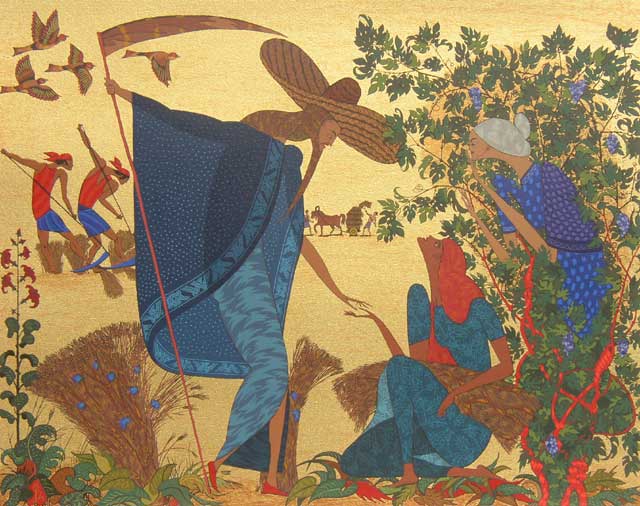
Ruth and Boaz (the stylistic work of Polish-Iraeli artist Shlomo Katz see here for more)

Reading for Pentecost 23, Sunday 12th November (Proper 32) Ruth 3:1-5, 4:3-17; Psalm 127; Hebrews 9:19-28; Mark 12:38-44

There is certain profound gentleness about this week's readings.
The story of a woman who finds a genuine life partner. And who against all odds becomes the mother of a great man.
And the gentle reassurance of the woman whose generosity is seen by God;
even though she gives little in "real terms"
she gives everything she has in hers
and God see this and we recognise it
and so we are heartened.
In the middle of this there is something of a sterner reminder
that God abhors hypocrisy
and that there is about life
the mystery of sacrifice
which tests us to the very core of who we are.
The writer to the Hebrews
spells out in great details
that sacrifice is at the core of what our relationship with God is all about.
Getting it straight
Now we need to understand that there is a common misconception about sacrifice
that it is essentially about the taking away of life.
This is not necessarily or particularly so.
In fact if we look at the detailed instructions about sacrifice
in the Hebrew scriptures
we see that a lot of it is not about animal slaughter at all
There are all sorts of sacrifices of grain and produce
which do not involve bloodshed.
In fact if we look at the word sacri-fice we can see that it is about making (the fice part of the word) things sacred or holy (the sacri part of the word)
Christ died that we might be made holy
In fact the writer of Hebrews uses the idea of Christ entering into God's presence
(going into the most holy place)
so that we too might enter into that presence
Simple reflection
The story of Ruth is an interesting but gentle tale.
It seems a simple love story
yet it needs also to be read in the context of the sort of ethnic tensions
that still exist in those lands we call HOLY today.
Ruth was not a Jew
she was what today we would call a Lebanese, or Syrian, perhaps even an Iraqi.
Yet her faithfulness to her Jewish mother-in-law
and her willingness to do what needed to be done
saw a simple little tale
become an object lesson
in the all accepting love of God.
The Jews were racked by ethnic division then as now.
And yet we read of one the greatest heroes
(in backwards order)...his father was Jesse, his grandfather was Obed, who was the child
not of a Jew but of a Moabitess.
David was the great grandson of an outcast.
Be careful about what you hear. There is more than meets the eyes.
Likewise in the letter to the Hebrews
it is the call for us to be holy
and the permission to enter the closest presence of God
that we need to hear.
Not just the bloody sacrifice of Christ.
So obsessed are we about guilt and sin
that we fail to hear that there is cause for rejoicing.
Christ died, so that we could be close to God.
God is close, not far.
Don't push him away
Finally

A simple tale that we all know to be true
.. the rich can afford to be generous
But do we also pay attention to the great warning
God is not looking for who gives the most
either in real dollar terms
or even proportionately.
God looks at the heart
and despises hypocrisy.
The hypocrisy that judges others and fais to critique oneself.
THIS WEEK
Where is God inviting me to be tolerant? To step outside my prejudices and to be more accepting?
Where do I hold back from drawing close to God? Is there a time and place to be quiet and listen? Is there an opportunity to serve God through care for others?
Where in my life am I most hypocritical? Where can I change and be more honest?